AI flow design for healthtech: evidence, confidence, and the override
A model’s answer only helps if a clinician acts on it and knows why. So we design the four things most AI health products leave to a tooltip: confidence, evidence, the override, and the wrong answer.

Why healthtech teams bring us in for AI flows
In clinical AI, trust comes from what happens when the model is wrong.
We design the failure and the override before the result screen.
Types of clinical AI flows we build
From the first clickable prototype to a suggestion a clinician acts on.
- 01Suggestion with its basisThe output, the evidence behind it, and the way to check that evidence.
- 02Confidence that means somethingA number a clinician can act on, not a percentage with no unit behind it.
- 03Override in one actionDisagreeing with the model is a first-class path, not a support ticket.
- 04Inconclusive resultsThe screen for when the model does not know, and what happens to the case.
- 05Triage and prioritizationModel output that reorders a queue without hiding what it moved.
- 06Audit and traceabilityWhich version said what, when, and who acted on it.
- 07Consent and data boundariesWhat the model sees, what leaves the building, and how a patient is told.
- 08Model change managementThe screens for the day the model is retrained and the outputs move.
The four flows an AI health product needs
Patterns from clinical and insurance work we have shipped.
Suggestion with its basis
One view shows the output, what it was derived from, and how sure the model is, in the clinician’s language. Confidence translates into a next step: review, confirm, or escalate.
Override in one action
Disagreeing is a primary button. Capturing the reason takes one tap. The model gets its feedback, and the record shows a human decided.
Inconclusive as a real result
“Not sure” gets a designed screen with a next step. Most clinical AI interfaces treat it as an error and push the user into a dead end.
Consent and data boundaries
What the model sees, what the data is used for, and what it never does. We write it into the flow in plain language, and your legal team reviews every word.
Our AI work in healthcare
Two published cases and the page on our wider AI practice.
Qantev
An AI platform applying mathematics to health insurance operations, with assisted review at its center.

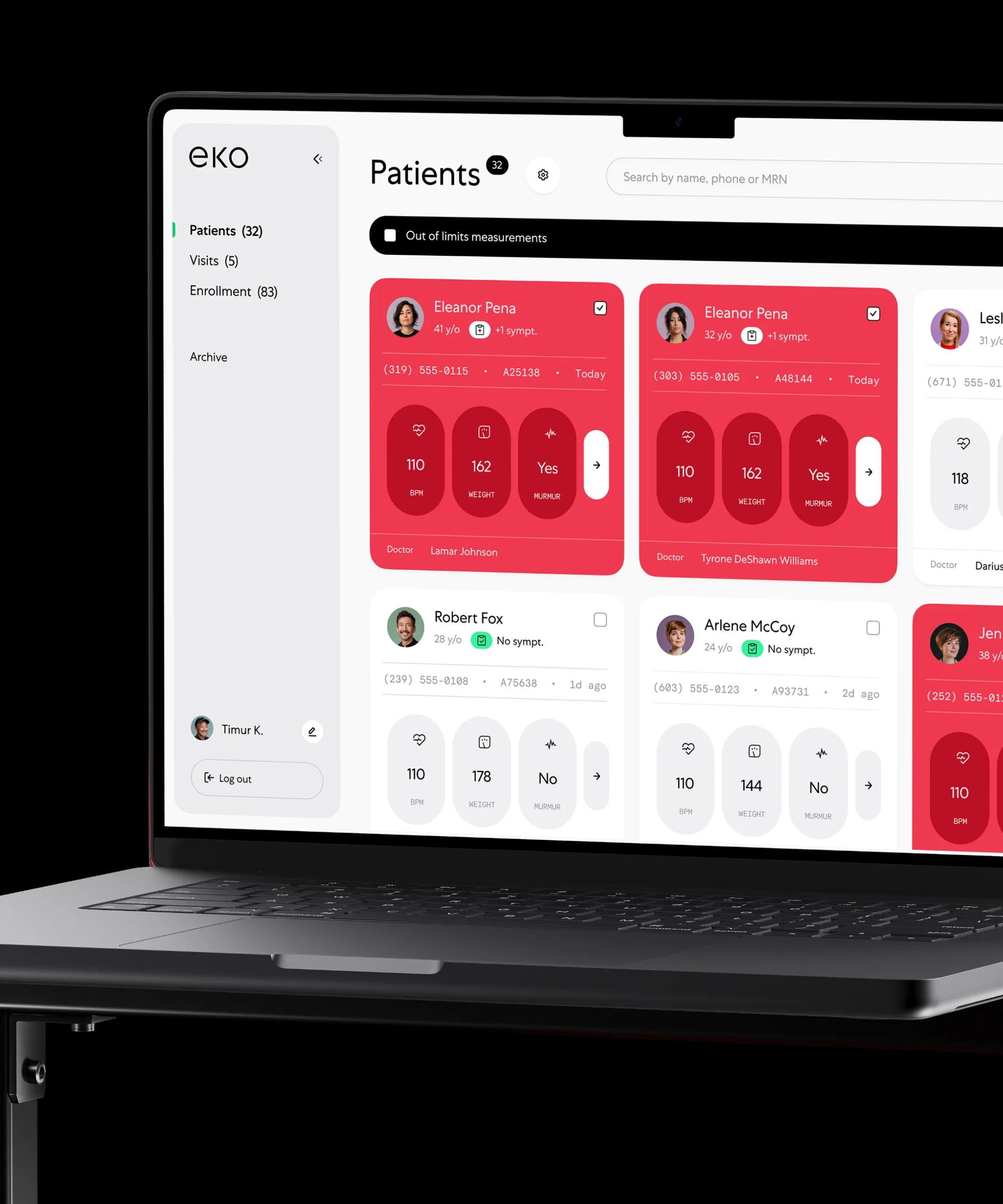
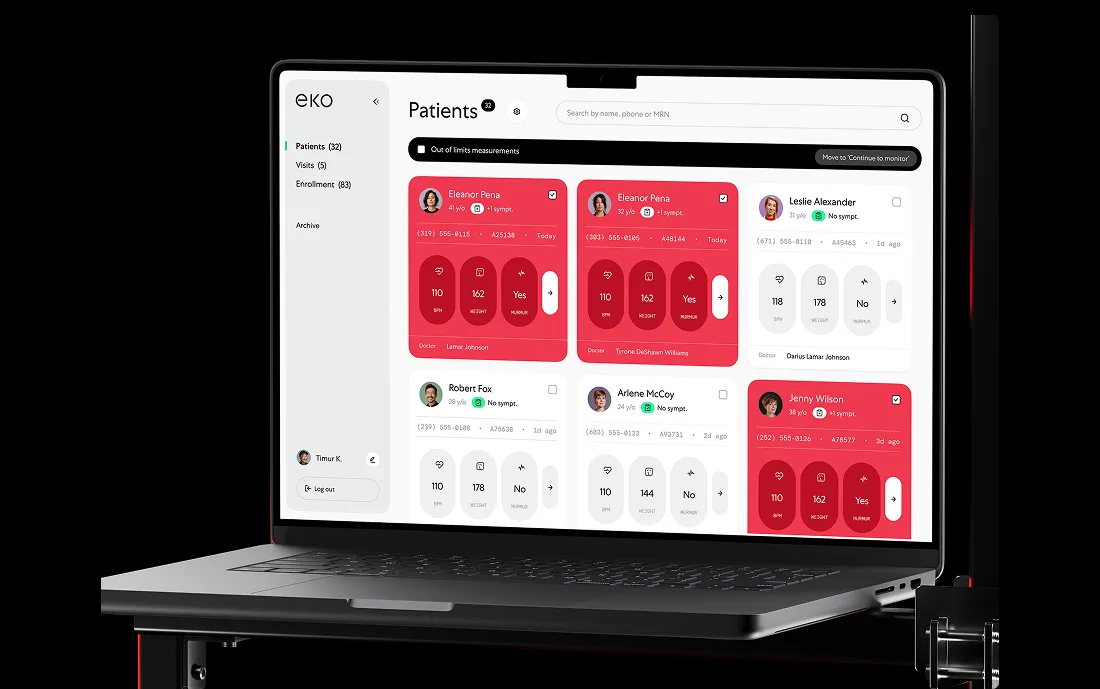
Eko Health
Advanced stethoscopes and smart assessment software, including the exam and result screens around the model.
AI agents inside a design team
Includes Pearl Dental AI, FDA-cleared diagnostics used by 29,000+ US dentists.
From idea to launch
The override is designed before the happy path.
Decision mapping
Which decision the model supports, who makes it, and what it costs to be wrong.
Evidence and states
Confident, uncertain, inconclusive, and wrong — all four designed as screens.
The override
Disagreement designed first, so the rest of the flow is built around it.
Interface and system
Components that carry evidence and audit trails, handed over in code.
Validate and ship
Tested with clinicians on real cases, then read against the numbers we agreed.
 B&T lab
“Their speed, quality, and positive attitude really impressed us.”
Evgeny Blagonravov · Founder&CEO
Read the full review
Join hundreds of teams. And counting.






































See what this would look like on your product.
Send the product and the deadline. You get a reply within 24 hours with the closest cases, a timeline and an estimate.
Questions?
How do you show model confidence to a clinician?
As a recommended next step, with the evidence attached. We pair the output with what it was derived from and translate confidence into an action: review, confirm, or escalate. The raw number stays available for the people who want it.
How do you design for the model being wrong?
Override is a primary action, capturing a reason takes one tap, and the record shows a human decided. Inconclusive results get a designed path instead of an error state. We design those screens before the happy path, because they decide whether the product is trusted after its first mistake.
Do you work with regulated AI medical devices?
Yes. We designed for Pearl Dental AI, FDA-cleared diagnostics used by 29,000+ US dentists, and for clinical device software at Eko Health. We are designers, not a regulatory consultancy: your quality and regulatory function owns the standard, and we make the interface meet it without becoming unusable.
Can you design the AI feature and the rest of the product?
Yes, and it usually works better that way. An assisted-review flow that clashes with the rest of the interface reads as a bolted-on experiment, and that impression is exactly what stops clinicians from using it.
What happens on the day the model is retrained?
The outputs move, and every clinician who trusted last week’s behavior notices. We design that day: what changes, who is told, what happens to cases already in the queue, and how a clinician sees which model version produced a result.
How do you know whether the flow worked?
We agree the numbers before the work starts — override rate and the reasons behind it, time to a decision, how often the evidence is opened, cases sent to escalation — and read them after release. A high override rate is not automatically a failure; not knowing why it is high always is.


Last updated